
Patrick Vernon’s book, Venture Capital StratFounder–Industry Fit – Why Venture Capitalists Invest in People Before Products
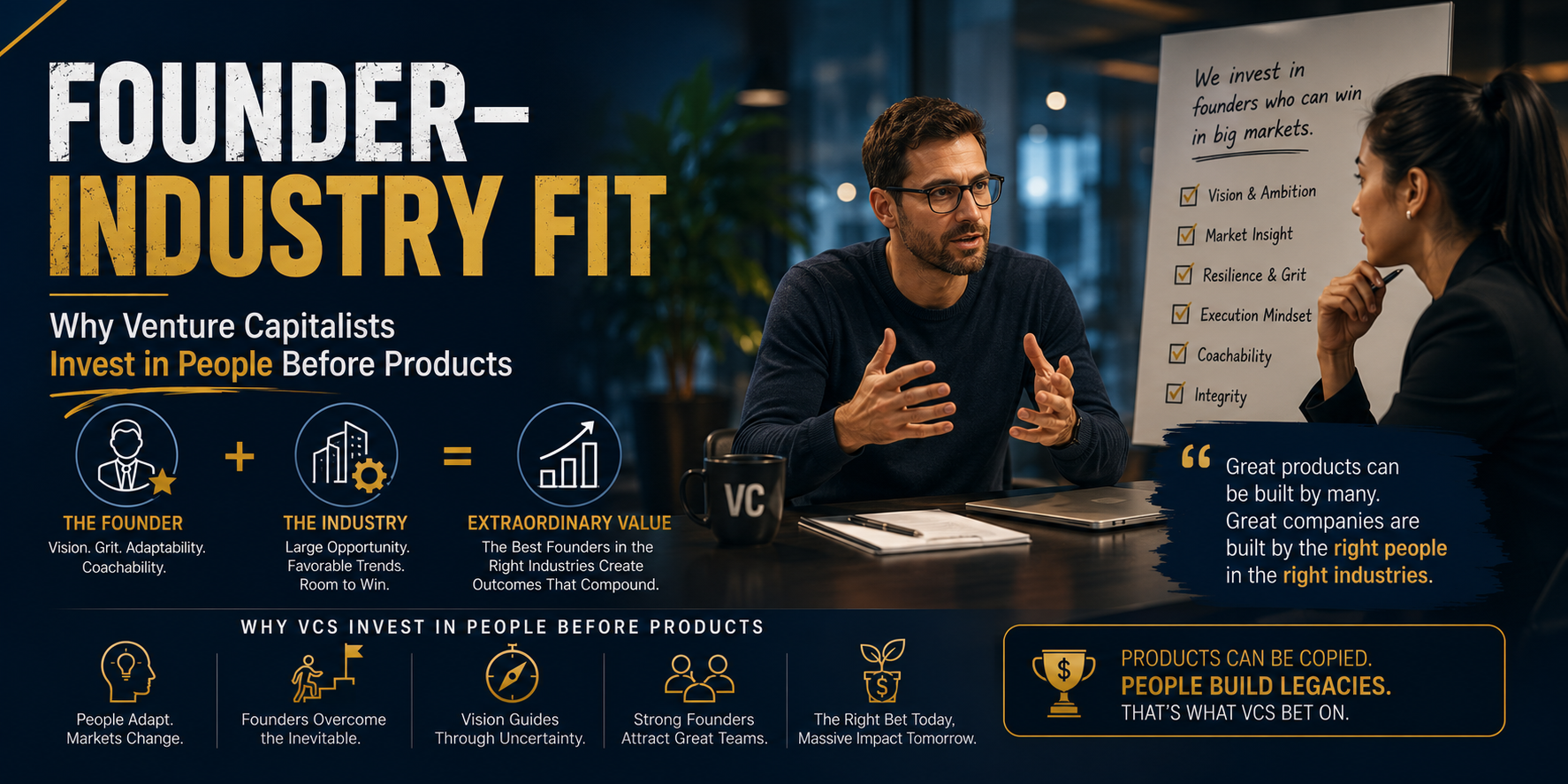
One of the most important things I learned from this section of Venture Capital Strategy: How to Think Like a Venture Capitalist by Patrick Vernon is that venture capitalists ultimately invest in people before they invest in products. Before reading this part of the book, I believed that the most important factor in securing venture capital was having an innovative product or an exciting business idea.
However, Patrick Vernon explains that although products and technologies are important, experienced venture capitalists understand that businesses constantly evolve. Markets change, customer preferences shift, competitors emerge, and technologies become obsolete.
Because of this uncertainty, investors place enormous importance on the founders leading the business. They believe that exceptional founders can adapt, pivot, solve unexpected problems, and continue creating value even when the original business idea changes. This completely changed my understanding of startup investing because I realized that the quality of leadership often determines whether a company survives difficult periods more than the originality of its first product.
The author repeatedly emphasizes that founders are not evaluated solely based on intelligence or academic qualifications. Instead, venture capitalists look for individuals who demonstrate strong execution abilities. Patrick Vernon explains that execution is the process of consistently turning ideas into measurable results. Many entrepreneurs can generate creative ideas, but far fewer possess the discipline, resilience, and leadership required to transform those ideas into successful businesses.
This distinction is important because startups operate in environments filled with uncertainty. Plans rarely unfold exactly as expected, meaning founders must continuously solve problems, make informed decisions under pressure, and maintain momentum despite limited resources. As I reflected on this lesson, I realized that execution is often a better predictor of long-term success than creativity alone. A brilliant idea without effective execution is unlikely to become a successful company.
Another lesson I found particularly valuable is the concept of founder–industry fit. Patrick Vernon explains that venture capitalists prefer founders whose knowledge, experience, and personal interests closely align with the industries they are trying to disrupt. This does not necessarily mean founders must possess decades of professional experience. Instead, they should demonstrate a deep understanding of the industry’s challenges, customer pain points, competitive landscape, and emerging opportunities.
Venture capitalists become more confident when they see entrepreneurs who genuinely understand the problems they are solving because such founders are more likely to build practical solutions that satisfy real market needs. Reading this section helped me understand that successful entrepreneurship is rarely about chasing fashionable industries. Rather, it involves solving problems that founders understand deeply and care about passionately.
Patrick Vernon also explains that venture capitalists pay close attention to a founder’s character and behaviour throughout the investment process. Investors observe how entrepreneurs respond to difficult questions, criticism, uncertainty, and unexpected challenges. During fundraising meetings, venture capitalists intentionally ask challenging questions not simply to test the business model but to evaluate the founder’s thinking process.
They want to know whether founders become defensive when challenged or whether they thoughtfully analyse problems and respond with evidence-based reasoning. This insight made me appreciate that fundraising is not merely a presentation of financial projections; it is also an assessment of leadership maturity. Venture capitalists seek founders who remain confident without becoming arrogant and who demonstrate humility while still maintaining conviction in their vision.
One aspect of the chapter that stood out to me is the author’s discussion about coachability. Patrick Vernon suggests that successful founders are individuals who remain open to learning even after raising investment capital. Since venture capitalists actively participate in strategic decisions through board membership and ongoing advisory roles, founders who refuse feedback may create unnecessary conflict that limits business growth.
This does not mean entrepreneurs should blindly accept every suggestion from investors. Instead, they should possess intellectual curiosity, listen carefully, evaluate advice objectively, and make informed decisions based on evidence. I found this lesson particularly meaningful because it highlights that confidence and humility are not opposites. Great entrepreneurs possess both qualities simultaneously—they believe strongly in their vision while remaining willing to improve their thinking.
The book also highlights the importance of resilience. Patrick Vernon explains that startup journeys rarely follow predictable paths. Product launches may fail, fundraising rounds may take longer than expected, talented employees may leave, and competitors may introduce unexpected innovations. Venture capitalists therefore search for founders who have demonstrated perseverance throughout previous challenges. Rather than viewing setbacks as permanent failures, resilient founders treat obstacles as opportunities to learn and refine their strategies.
This perspective reminded me of the author’s earlier discussion about California’s culture of accepting failure as part of innovation. Throughout the book, Patrick Vernon consistently reinforces the idea that resilience is not simply a desirable personality trait—it is an essential requirement for building companies capable of surviving uncertainty.
Another important lesson concerns leadership beyond technical expertise. Patrick Vernon makes it clear that building a successful startup requires much more than creating excellent technology. Founders must recruit talented employees, inspire teams, communicate effectively with investors, negotiate partnerships, establish company culture, and make difficult strategic decisions.
Venture capitalists therefore assess whether founders possess the emotional intelligence and leadership capacity required to build organisations rather than simply develop products. As companies grow, founders transition from solving technical problems personally to leading increasingly complex teams. Investors recognize this transition and evaluate whether entrepreneurs demonstrate the leadership potential necessary to scale alongside their businesses.
Personally, this section challenged my previous assumptions about entrepreneurship. I had often believed that successful startups primarily depended on innovative products or access to funding. Patrick Vernon helped me realize that people remain the most valuable asset within any entrepreneurial venture.
Technologies evolve, markets fluctuate, and business models change, but capable founders continue learning, adapting, and creating opportunities under changing conditions. This lesson extends beyond venture capital because it applies equally to leadership in business, government, and nonprofit organisations. Sustainable success depends not only on ideas but also on the character, competence, and determination of the people responsible for executing those ideas.
In conclusion, this section fundamentally changed how I evaluate entrepreneurial success. Patrick Vernon demonstrates that venture capitalists consistently prioritise founders because they understand that businesses are ultimately built by people rather than products. Leadership, execution, resilience, coachability, industry knowledge, integrity, and the ability to build outstanding teams collectively determine whether entrepreneurs can transform ambitious ideas into sustainable companies.
I now appreciate why experienced venture capitalists spend considerable time evaluating founders before making investment decisions. Their goal is not simply to identify attractive products but to identify exceptional leaders capable of navigating uncertainty and creating long-term value. This lesson stands out as one of the most practical and enduring insights I gained from the book because it shifts attention from ideas alone to the people responsible for bringing those ideas to life.