

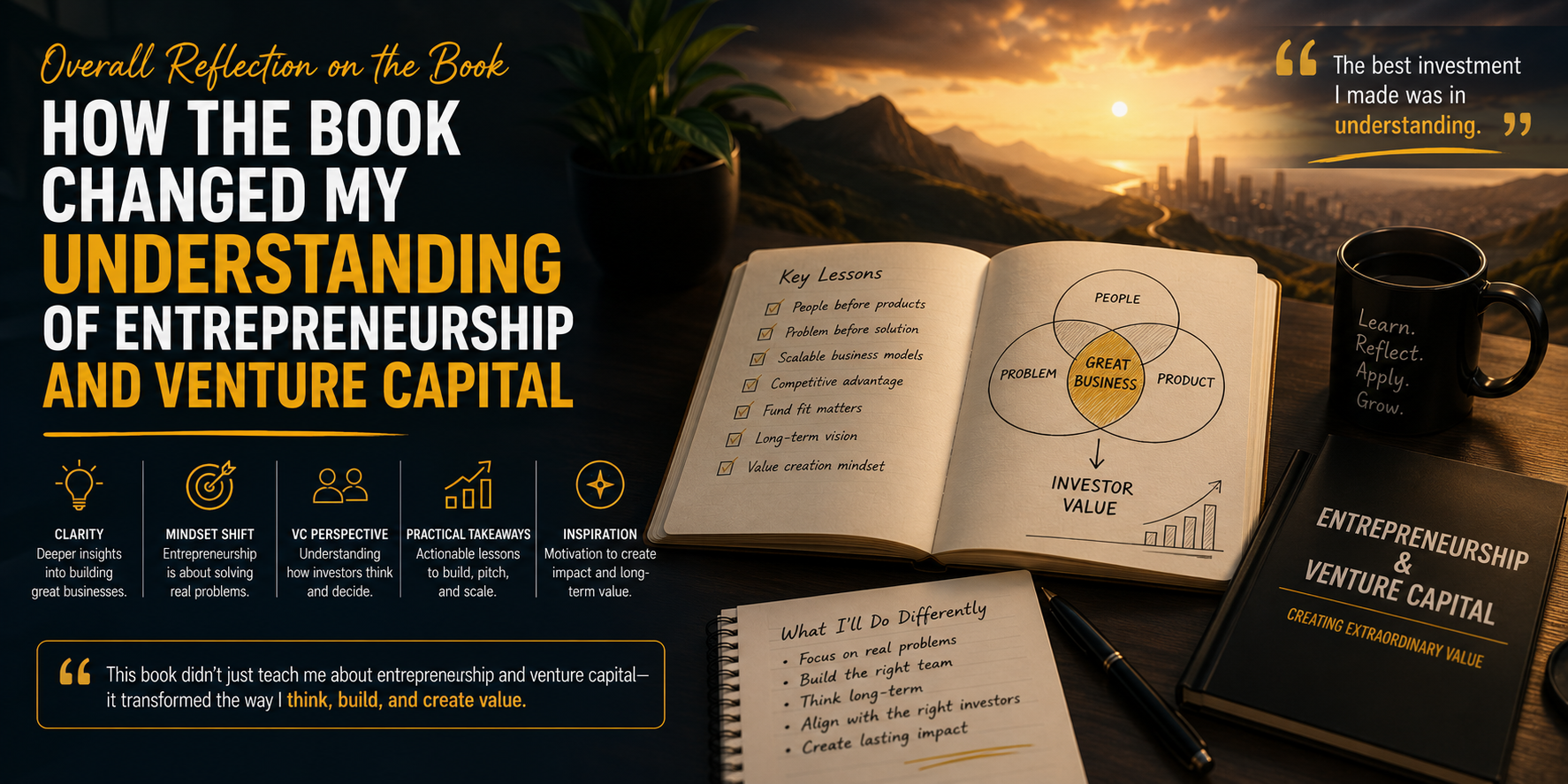
Overall Reflection on the Book – How the Book Changed My Understanding of Entrepreneurship and Venture Capital
One of the greatest lessons I gained from reading Venture Capital Strategy: How to Think Like a Venture Capitalist is that venture capital is fundamentally a way of thinking rather than simply a source of finance. Before reading this book, I assumed that venture capitalists primarily existed to provide funding to promising startups. However, the author demonstrates that their real responsibility is to allocate capital in a disciplined manner that maximizes long-term returns for their investors. Every investment decision is therefore influenced by probability, risk, timing, portfolio performance, market opportunity, and the likelihood of achieving extraordinary growth.
This perspective completely changed the way I now understand entrepreneurship. I no longer see a startup simply as a business that solves a problem; instead, I now understand that every startup is evaluated as an investment opportunity with measurable risks and expected financial outcomes. The book therefore shifted my mindset from thinking like an entrepreneur alone to appreciating the structured and analytical thinking of an investor.
Another important lesson I learned is that successful entrepreneurship requires balancing passion with objective business fundamentals. Throughout the book, Patrick Vernon consistently emphasizes that while enthusiasm, innovation, and determination are valuable qualities, venture capitalists ultimately invest based on evidence rather than emotion. Founders must demonstrate that their ideas solve significant market problems, possess scalable business models, have competent leadership teams, and operate in industries capable of producing substantial returns. The author repeatedly shows that investors do not reward ideas simply because they are creative; they reward businesses that have the highest probability of becoming category leaders.
This understanding has reshaped the way I think about innovation. Rather than asking whether an idea sounds exciting, I now appreciate the importance of asking whether the market is large enough, whether customers will consistently pay for the solution, and whether the business possesses sustainable competitive advantages over existing alternatives.
The book also deepened my appreciation for the importance of disciplined decision-making under uncertainty. Patrick Vernon explains that venture capitalists rarely possess complete information before making investment decisions. Instead, they develop frameworks that allow them to evaluate incomplete data, compare opportunities objectively, and make informed judgments despite uncertainty. This principle extends far beyond venture capital and applies to leadership, business strategy, investment analysis, and personal decision-making.
I particularly appreciate how the author demonstrates that uncertainty should not discourage action but should instead encourage better preparation, continuous learning, and systematic evaluation. Successful investors do not eliminate uncertainty; they learn how to manage it intelligently. This lesson has influenced my own perspective on decision-making by encouraging me to become more analytical while remaining willing to embrace calculated risks.
Another valuable insight from this book is the realization that failure is not necessarily the opposite of success but often an essential component of achieving it. Throughout the historical development of venture capital, particularly within Silicon Valley, the author illustrates how failure is viewed as a learning process rather than a permanent setback. Venture capital firms expect that many investments will fail, yet they continue investing because a small number of exceptional companies generate returns that compensate for numerous unsuccessful ventures.
This philosophy differs significantly from conventional business thinking, where failure is often perceived negatively. Instead, the venture capital mindset encourages resilience, continuous experimentation, and learning from mistakes. As an aspiring entrepreneur, this perspective has become one of the most encouraging lessons I have gained because it reinforces the importance of persistence, adaptation, and continuous improvement instead of fearing setbacks.
Finally, this book has fundamentally broadened my understanding of entrepreneurship by revealing that building a successful company involves much more than creating products or generating revenue. Entrepreneurs must understand investors, capital structures, ownership dilution, fundraising strategies, governance, market timing, competitive positioning, portfolio economics, and long-term exit planning.
Patrick Vernon successfully combines historical background, practical venture capital processes, financial concepts, and real-world case studies to explain how professional investors evaluate businesses from beginning to end. Rather than presenting venture capital as a mysterious industry accessible only to financial experts, the author simplifies complex concepts without sacrificing depth, making the subject highly practical and engaging.
Overall, Venture Capital Strategy: How to Think Like a Venture Capitalist has significantly expanded my knowledge of entrepreneurship, investment strategy, and innovation. It has encouraged me to think more strategically, evaluate opportunities more objectively, and appreciate the importance of combining vision with disciplined execution. This book is an excellent resource for entrepreneurs, business students, startup founders, investors, and anyone interested in understanding how successful ventures are identified, funded, developed, and transformed into globally impactful companies.